Thank you for registering for the introductory community-based social marketing workshop. Use this forum prior, during, and after the workshop to share information and dialogue with participants, co-hosts, and myself.
Introductory Workshop
Sign in or Sign up to comment
Link to the Six Americas work - https://climatecommunication.yale.edu/about/projects/global-warmings-six-americas/
Q - Super curious what, if anything you've found to work as this "face-to-face" in the era of covid. It's something we struggle with as an org that used to have a nearly all in-person outreach approach but who has had to become creative in the era of social distancing
A - We have had to change research and recommended outreach methods because of Covid. More phone calls (when possible), Zoom for focus groups, and mail. There was some in-person last summer when things were a little brighter, but with a pre-notification card stating the volunteers were coming and would be far from the front door, etc.
Qs related to availability / gathering initial data
A1 - it can be tough to find publicly available information. Usually much of this type of categorization is done for specific projects. Usually we start with a literature review and identify other programs that have worked on what the project we are interested in. Then reach out to them and see if they have information they can share. after that, you would do some research (surveys, focus groups, etc.) to gather or refine data.
A2 - the amount of data available generally depends on the behavior. some (like picking up pet waste, recycling cardboard, etc.) have much more data than newer, or specialized behaviors
A3 - picking the right behaviors is very important. otherwise you could pick the wrong behaviors then the program doesn't work. If you could at least do a literature review that can be done for low cost. There are other ways to capture a little bit of data that doesn't cost a ton of money. for example, take a weekend and go out to intercept people at the local library.
A1 - it can be tough to find publicly available information. Usually much of this type of categorization is done for specific projects. Usually we start with a literature review and identify other programs that have worked on what the project we are interested in. Then reach out to them and see if they have information they can share. after that, you would do some research (surveys, focus groups, etc.) to gather or refine data.
A2 - the amount of data available generally depends on the behavior. some (like picking up pet waste, recycling cardboard, etc.) have much more data than newer, or specialized behaviors
A3 - picking the right behaviors is very important. otherwise you could pick the wrong behaviors then the program doesn't work. If you could at least do a literature review that can be done for low cost. There are other ways to capture a little bit of data that doesn't cost a ton of money. for example, take a weekend and go out to intercept people at the local library.
Q - Is academic literature easily accessible if not affiliated with universities ?
A1 - some of it is. a great resource is Google Scholar: https://scholar.google.com/ if you come across an article that you cant access - send the author an email. They are very likely to send it to you
A2 - In Québec it's really hard to find free academic literature, but some researcher offer their article in open access journals
A1 - some of it is. a great resource is Google Scholar: https://scholar.google.com/ if you come across an article that you cant access - send the author an email. They are very likely to send it to you
A2 - In Québec it's really hard to find free academic literature, but some researcher offer their article in open access journals
Here are the links to the book on Quasi-Experiential Design:
Experimental and Quasi-Experimental Designs for Research, Campbell and Stanley, 1966 https://www.sfu.ca/~palys/Campbell&Stanley-1959-Exptl&QuasiExptlDesignsForResearch.pdf
https://www.amazon.ca/Experimental-Quasi-Experimental-Designs-Research-Campbell/dp/0395307872/ref=sr_1_2?dchild=1&keywords=Experimental+and+Quasi-Experimental+Designs+for+Research&qid=1635291612&s=books&sr=1-2
Experimental and Quasi-Experimental Designs for Research, Campbell and Stanley, 1966 https://www.sfu.ca/~palys/Campbell&Stanley-1959-Exptl&QuasiExptlDesignsForResearch.pdf
https://www.amazon.ca/Experimental-Quasi-Experimental-Designs-Research-Campbell/dp/0395307872/ref=sr_1_2?dchild=1&keywords=Experimental+and+Quasi-Experimental+Designs+for+Research&qid=1635291612&s=books&sr=1-2
Q - Who do you use for text message automation service?
A - We use Sakari and integrate it with workflows in our CRM (Hubspot)
Case study on communication via local news weather people: https://toolsofchange.com/en/case-studies/detail/743
Recycling Resources:
https://www.fcgov.com/recycling/files/recycling-guidelines.pdf?1633452053
https://sustainablecampus.cornell.edu/news/mini-bins-make-big-waste-impact-campus
https://recollect.net/waste-wizard/
www.recyclebycity.com/chicago
https://www.fcgov.com/recycling/files/recycling-guidelines.pdf?1633452053
https://sustainablecampus.cornell.edu/news/mini-bins-make-big-waste-impact-campus
https://recollect.net/waste-wizard/
www.recyclebycity.com/chicago
Clean marina program: https://floridadep.gov/rcp/clean-marina/content/clean-marina
Q - Is there a useful way to think about participating in the ubiquitous "community fair" where you are required to show up and spend some time? These can sometimes be a big sink of time and money. If the referent group is coming to the "fair" it seems like a chance to do some interviews to discover barriers, etc.?
A1 - we have a booth at our county fair every year and we have volunteers from the local highschool senior class that help at our booth. We do surveys and we send them around throughout the fair to also capture survey completion from others who may not be coming through our booth. It works great !
A2 - community events are great places to gather data. a small half sheet of paper survey can gather information on knowledge, attitudes, behaviors, etc. They can also be good places to gather commitments. For example, a county we work with goes to local pet events to get commitments to pick up pet waste at least once a week.
A1 - we have a booth at our county fair every year and we have volunteers from the local highschool senior class that help at our booth. We do surveys and we send them around throughout the fair to also capture survey completion from others who may not be coming through our booth. It works great !
A2 - community events are great places to gather data. a small half sheet of paper survey can gather information on knowledge, attitudes, behaviors, etc. They can also be good places to gather commitments. For example, a county we work with goes to local pet events to get commitments to pick up pet waste at least once a week.
Q - How does framing on loss interact with the earlier things you said about wanting to promote what to do and not what not to do?
A1 - Example - "You can stop X loss by doing Y." You are promoting the desired behavior
A2 - It involves how you frame something, so you would say "most of your neighbors are only watering one day a week to NOT WASTE WATER" vs "most of your neighbors are only watering one day a week to SAVE WATER
A1 - Example - "You can stop X loss by doing Y." You are promoting the desired behavior
A2 - It involves how you frame something, so you would say "most of your neighbors are only watering one day a week to NOT WASTE WATER" vs "most of your neighbors are only watering one day a week to SAVE WATER
Q - does the random selection need to be a certain percentage of the whole to get to representation?
A - it depends on a few factors. here is a quick overview that you could check out. https://www.qualtrics.com/experience-management/research/determine-sample-size/
An example of using an already existing app - There was a project working with tapirs in Costa Rica that was teaming up with the waze navigation app in order to alert drivers to slow their speed when entering an area where tapirs had been seen in order to reduce instances of vehicle collisions.
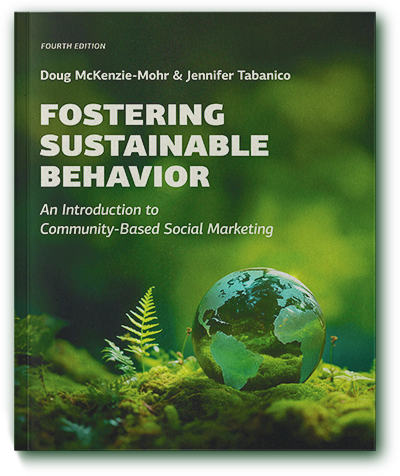
How do we download the book? It's asking me for a password/link but I never received one.
I am looking for the passcode myself. Did you ever find it?
These two books by Jonah Berger were mentioned during the workshop today, The Catalyst: How to Change Anyone's Mind and Contagious: Why Things Catch On.
Books | Jonah Berger
...