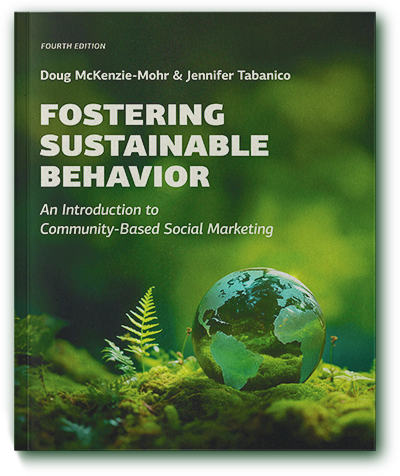
Thank you for registering for the introductory community-based social marketing
workshop. Use this forum prior, during, and after the workshop to share information and
dialogue with participants, co-hosts, and myself.
Introductory Workshop Discussion Forum
Sign in or Sign up to comment
Q: Our society jumps to education as the answer to all of our problems. Does this research essentially demonstrate that it isn't the case in reality?
A1: I guess its part of the answer, not enough by itself?
A2: it's not to say that education isn't a solution, it's just not always the BEST or the ONLY solution. But it is commonly one that people default to.
A3: There’s been a few different studies across various industries that have shown that education alone isn’t the answer to full behaviour change
A1: I guess its part of the answer, not enough by itself?
A2: it's not to say that education isn't a solution, it's just not always the BEST or the ONLY solution. But it is commonly one that people default to.
A3: There’s been a few different studies across various industries that have shown that education alone isn’t the answer to full behaviour change
Q: Can you legally use drone footage if people are involved?
A1: Can collect for compliance in Australia and then could use the footage if working with/conducting research with an agency
A2: that would vary by jurisdiction. That's something to verify first, but It shows how you can get creative when collecting data
A3: Used in waste and marine park management in Queensland and waste in other states
A4: https://www.aelert.net/search?q=drones
A1: Can collect for compliance in Australia and then could use the footage if working with/conducting research with an agency
A2: that would vary by jurisdiction. That's something to verify first, but It shows how you can get creative when collecting data
A3: Used in waste and marine park management in Queensland and waste in other states
A4: https://www.aelert.net/search?q=drones
Q: How do you define 'impact' when describing it to the experts?
A: you need to put it in context of the ultimate goal for them. So for example - when working on preventing pesticide pollution, we ask how much of a reduction certain actions (use bait stations, do not spray within 48hrs of predicted rain, etc.) would have on the amount of pesticides reaching local waterways.
Q: can you explain again how you get the applicability number?
A: applicability usually comes from census type data, or consumer data. For example, if you are encouraging single family homeowners to install solar, applicability is the percentage of single family home owners in the population.
Resources for Litter/ Balloons:
Insights.litterintelligence.org
zoo.org.au/balloons
Insights.litterintelligence.org
zoo.org.au/balloons
Q: Can you address perceived barriers with information (myth busting)?
A: you can if the barrier is lack of knowledge, this applies a lot to recycling. However, often you can use other tools to get more effective change. For example, you can use feedback to compare a person's energy use to their neighbors. This will convey a social norm which can be more effective than information alone.
Tools of Change Website:
https://toolsofchange.com
Q: Can you clarify "active" commitment?
A: you want to get them to actively say "yes" or "I commit" or to specifically sign their name to a commitment card. Rather than for example passively handing them a card that outlines the commitment, but they don't need to do anything to affirm it.
Book on Soap Operas is called "Soap Operas for Social Change"
https://www.amazon.com/Soap-Operas-Social-Change-Entertainment-Education/dp/0275943895
Hi Doug, Joey,
Do you have any recent case studies that focus on successful behavior change programs around reducing kerbside recycling contamination across Australia?
Thanks
Tash
Do you have any recent case studies that focus on successful behavior change programs around reducing kerbside recycling contamination across Australia?
Thanks
Tash
Q: The digital version of the book does not have the copyright page for citation.
A: a scan of my hard copy is attached here
1 Attachment:
I don't have any Australia specific case studies, but here is a quick writeup of a project we worked on here in the US.
1 Attachment:
Q: questions about promoting fines or penalties
A: penalties can fall into the tool of "incentives" (they are a disincentive) and they should be used carefully because there are many ways they can undermine the program. For example, after they are removed, behaviors can rebound to pre incentive level (and in some instances even WORSE than before). prioritizing fines can be tricky. unless people actually get fined regularly it can undermine the message. Here in the US there are $1000 fine for littering signs all over the highway, but no one is really ever fined, so it doesn't resonate.
Q: Is it important to have data to suggest that the community does actually believe this behaviour is important or can you simply say this as an assumption to motivate the community?
A: you absolutely should have real data to make those claims. if not, it could backfire if people find out. Typically we conduct a survey and use data from there.
...
I've copied his google scholar link below with some of his work which might be useful :)
https://scholar.google.co.uk/citations?user=W2CdJGkAAAAJ&hl=en
Feel free to contact me if you can't access something and I'll see if I can help you out!
Cheers,
Meg