Thank you for registering for the introductory community-based social marketing
workshop. Use this forum prior, during, and after the workshop to share information and
dialogue with participants, co-hosts, and myself.
Introductory Workshop Discussion Forum
Sign in or Sign up to comment
Good Morning. Looking forward to the workshop this week.
Q: Is the Hawthorne effect the same as the Experimenter Demand Effect?
A1: The Demand Effect is more about people trying to "please" the experimenter. A2: These are related concepts. Demand effects generally come about when the participant wants to behave according to how they believe the experimenter wants them to. Hawthorne effects are changes in behavior simply by being observed.
Resources related to audience profiles and identity pertaining to climate (e.g., Six Americas): https://www.climatechangecommunication.org/resources/
See also: https://climatecommunication.yale.edu/
Q: I am not advocating shame and guilt I just wonder how it plays into social norms.
A: this isn't covered in the workshop, but recent work on social norms indicates that social norms messages are more persuasive when they are framed in terms of deviating from the perceived norm rather than conforming to it. For example, it the perceived norm is that "most people wear a mask", then pointing out negative characteristics of those who do not wear a mask (people who don't wear masks are irresponsible) can be more influential than pointing out positive characteristics of people confirming to the norm (people who wear masks are responsible). Conversely, if the perceived norm is that "no one else is wearing a mask", then messages that highlight positive characteristics of people who deviate from that (people who wear masks are responsible) can be more effective.
Q: Can we get a list of the take home points?
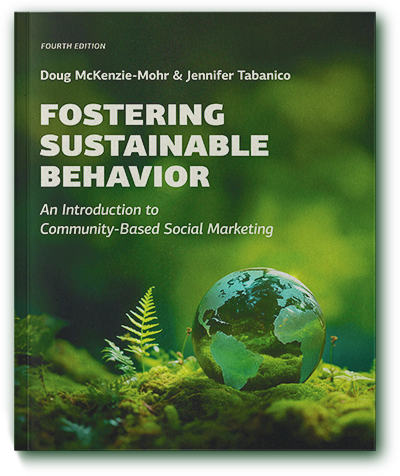
A: The take home messages are not always presented in the same order during the workshop as they often emerge from the questions that are asked by participants. However, all of the take home messages are in the CBSM book. You'll see them in the margins with an icon of a house. Other important points are also in the margins with an icon of a hand with a string tied around a finger.
Q: Can you summarize what’s within those two phases Doug just mentioned (re funding)?
A: We suggest funding in phases. First, fund behavior selection in phase 1. Second, fund barrier/benefit research and strategy design. Third, fund pilot testing (using a 3rd party if budgets are large). Then fund implementation only of effective strategies. Phase 1/2 could feasibly be combined to fund in 3 phases.
Q: [In relation to prompts] If it is in a place they see every day I think they will just tune it out
A: yes. that is true. Eventually they it will not be noticeable. However, we typically are relying on habits to form. That is, we place the reminders so that they are there long enough for the behavior to become habit or part of a routine.
Q: Does lack of knowledge of benefits count as a barrier?
A: Knowledge about how to do something or knowledge about it's importance can be barriers. However, benefits are typically motivators (not barriers). Importantly, actual benefits (e.g., improved water quality) may not same perceived benefit by your target audience.
Q: “preventing tire wear” is interesting because I can envision multiple benefits that are latched onto this - car lasting longer, not having to spend $ on new tires or repairs, etc. Anyone have ideas for how to parse out which benefit is the “primary” one when there are multiple benefits associated with it?
A: we often use multivariate statistics (e.g., comparing means) to determine which are the most important benefits. We often use 0 - 10 scales. Some benefits will rise to the top. Others will be less important.
Q: [In relation to identifying your organization when speaking with people] What if there's a lot of skepticism about messaging from your organization?
A: if people are skeptical about your organization you might want to consider partnering with another local group that is more trusted. We run into this sometimes where a County is seen as too governmenty but they partner with a local NGO to deliver messages.
Q: I’m also curious about how to incorporate community based decision making into this process… finding a way to involve community members in the solutions, so that they have some ownership over the strategies and impact. Similarly, how do you ensure the barriers/benefits analysis is equitable and fully representative?
A: Great questions. You may want to ask this of the group as it is a more substantive question than I can answer briefly in chat. What you are asking about is the concept of co-creation and there are a of of people doing this these days. While there are upsides to making sure that the messages are well-understood, there are challenges including group members do not have understanding of behavioral science and often people are not good judges of what motivates then. Again -- I'd suggest raising your hand to ask this. [this was then discussed at the group level]
Q: Has there been any research to try to determine what percentage of the population is both well known and well respected? I’m thinking of the personality tests done in leadership training programs and they are able to say that, for instance, 18% of the population is in group A, 22% in group B, etc.
A: I am not aware of anything that has been done on this broadly. However, I expect that in this context it would vary by the behavior and community. For example, we did some work in a local neighborhood trying to get people to install drip irrigation. We identified (via survey work) the person that was perceived by the community as being well-respected in terms of gardening practices. We then approached this person to help speak with others. Similarly, we worked with farmers in Tennessee on sustainable agricultural practices. In that project, we learned from other local farmers who they perceived to be the farm that was well known and well respected in terms of trying new innovations.
Q: how do we search the cbsm articles? I didn’t see a search option when I was poking around on the site.
A1: It appears that the best way to do this is to filter your search based on various topics or tools. For example, if you are interested in articles on energy, click the energy icon and it will say that there are 256 articles related to energy. You can then further filter by specific tools applied. I don't believe that there is a search bar.
A2: you can also filter by sub-topics. For example, if you click on "Conservation" you will see that there are 13 articles, 1 case study, 70 forum posts, and 104 colleagues in this category. If you then click on "Native Plants" subcategory, you will then see 1 article and 17 forum posts and 65 colleagues.
A1: It appears that the best way to do this is to filter your search based on various topics or tools. For example, if you are interested in articles on energy, click the energy icon and it will say that there are 256 articles related to energy. You can then further filter by specific tools applied. I don't believe that there is a search bar.
A2: you can also filter by sub-topics. For example, if you click on "Conservation" you will see that there are 13 articles, 1 case study, 70 forum posts, and 104 colleagues in this category. If you then click on "Native Plants" subcategory, you will then see 1 article and 17 forum posts and 65 colleagues.
Q: for clarification, a descriptive norm is essentially when we see someone else doing something, and we start doing what those people do?
A: yes, descriptive norms are based on what we see other people doing. We look to other for guidance on how we should behave. For example, when you approach an unfamiliar waste bin and you look inside to see what others are placing in it (trash or recycling).
Q: what’s the difference between the “rebound effect” and the “magnetic middle effect”?
A: the magnetic middle effect is the tendency for people to retreat to the norm. For example, if we point out that an individual is using less energy than their neighbors, they will increase their use to be in line with the norm.
Rebound effects refer to the tendency for people to engage in behaviors opposite to what is intended because of highlighting the wrong norm. That is, people go with the norm even if they are doing the wrong thing.
A: the magnetic middle effect is the tendency for people to retreat to the norm. For example, if we point out that an individual is using less energy than their neighbors, they will increase their use to be in line with the norm.
Rebound effects refer to the tendency for people to engage in behaviors opposite to what is intended because of highlighting the wrong norm. That is, people go with the norm even if they are doing the wrong thing.
Q: when is it okay to pair a benefit, that feels like an incentive with a behavior, and when is it not?
A: incentives are best paired with one time behaviors. For example, a rebate to get a high efficiency water heater.
Q: We've talked a lot about the negative impact of incentives, but we've also talked about rewarding behavior. Can you share a little bit more about the distinction you're making between incentives and reinforcement? Is it just the stage that the reward takes place within?
A: generally incentives involve giving people something tangible. Reinforcements can be provided without giving people anything in particular (e.g. getting a smiley face on your electric bill for reducing consumption).
Q: Do prompts become less effective if messaging is constantly changing? For example when we educate about recycling, we are constantly trying to keep up with changes in what is accepted vs not. There is also confusion because what they know, may be different than what is relevant to their referent groups due to different haulers etc.
A: the issue that you raise is a good example of how not every tool is appropriate for every situation. If you are using a prompt for recycling it would be good to focus on those core items that are not likely to change (cardboard, aluminum, etc.). But at the higher level, you'll need to use other tools like a commitment to regularly check for updated guidelines. Or maybe even a prompt text message to remind them to check new guidelines. Recycling is tricky!
...